
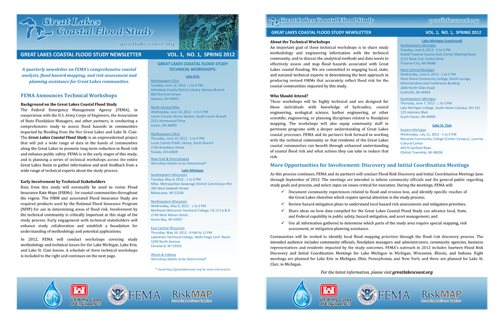
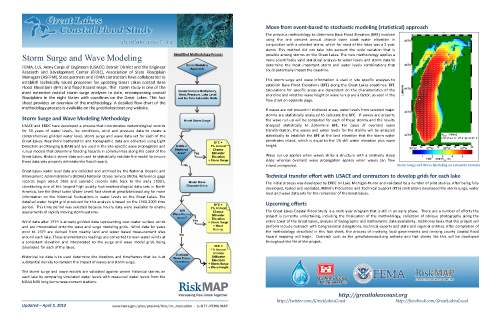
Great Lakes Coastal Flood Study has finalized three of the reports related to this 2012 Federal Inter-Agency Initiative. The reports linked below deal with the Statistical Storm Analysis, Dune Erosion and the CSHORE Numerical Model.
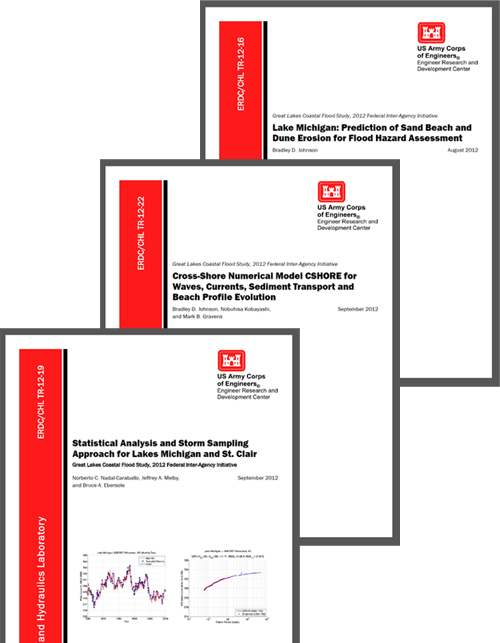
Great Lakes Coastal Flood Study Published Reports
[US Army Corp of Engineers]
- Statistical Analysis and Storm Sampling for Lakes Michigan and St. Clair [3.68 MB .pdf],
Norberto C. Nadal-Caraballo, Jeffrey A. Melby, and Bruce A. Ebersole, U.S. Army Corps of Engineers
(Final Published Report, September 2012) - Lake Michigan: Prediction of Sand Beach and Dune Erosion for Flood Hazard Assessment [1.0 MB .pdf],
Bradley D. Johnson, U.S. Army Corps of Engineers
(Final Published Report, September 2012) - Cross-Shore Numerical Model CSHORE for Waves, Currents, Sediment Transport
and Beach Profile Evolution [2.17 MB .pdf],
Bradley D. Johnson, Nobuhisa Kobayashi, and Mark B. Gravens, U.S. Army Corps of Engineers
(Final Published Report, September 2012)
Links to resources like the Published Reports above are posted on the Technical Resources page.





 RSS Feed
Technical Resources Page Added to greatlakescoast.org
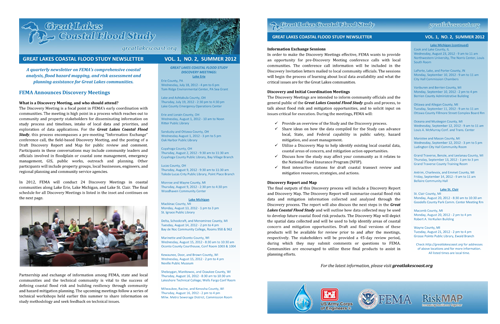
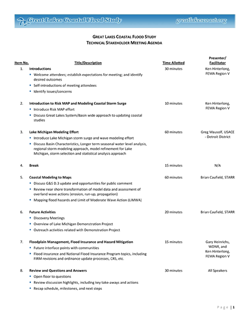
May 7, 2012 — Great Lakes CoastA new page has been added to the Great Lakes Coastal Flood Study website in the menu on the left called Technical Resources. The Technical Resources page contains links to data and reports of interest to engineers and other technical stakeholders interested in the Great Lakes Coastal Flood Study.
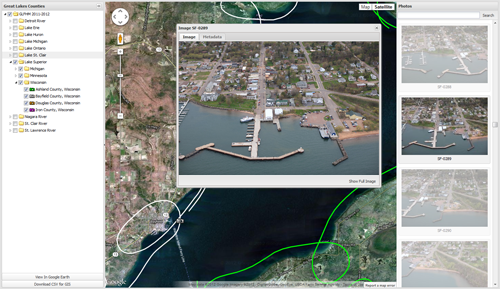
As of this posting, there is a link to high-resolution bathymetric and topographic LiDAR data on NOAA’s Coastal Services Center Digital Coast website. In June 2012, additional data links will go live, including the C-STORM wave and storm surge database (containing all the wind, wave, pressure, ice and water level data for the Great Lakes basin) and the Great Lakes Oblique Photo Viewer (containing all the coastal oblique photographs of the Great Lakes shoreline).
The Technical Resources page also currently houses links to U.S. Army Corps of Engineers reports relevant to the Great Lakes Coastal Flood Study, as well as a link to the FEMA Great Lakes Coastal Guidelines, Appendix D.3 Update at fema.gov, which includes information on the 60-day public comment process that starts today.
All stakeholders are invited to review and comment on this draft guidance. See FEMA’s webpage for e-mail address for submission of comments.
Tags: Guidelines, Public Comment, Technical Resources.